Facebook
 twitter


Supercomputer predicts 2026 Royal Ascot Gold Cup result

irishracing.com news

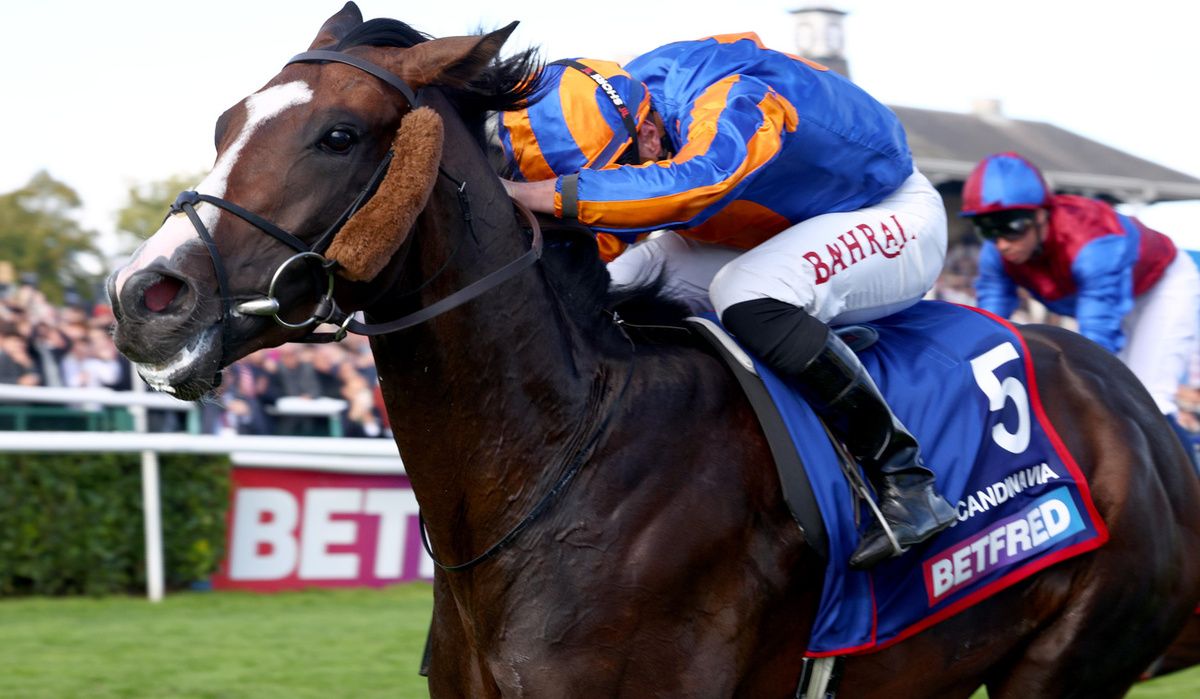 Scandinavia
© Healy Racing Photos
Racing fans will be poring over every angle to find the winner, especially with last year's record-breaking hero Trawlerman not certain to defend his crown after missing his intended prep runs, and Aidan O'Brien's Scandinavia emerging as the would-be new king of the stayers. To cut through the noise, we have fired up our supercomputer to assess which horse has the best chance of winning the 2026 Gold Cup.
How The Supercomputer Works
The data experts at irishracing formulated a complex and industry leading algorithm to best assess the chances of the competing horses in the 2026 Ascot Gold Cup.
The algorithm runs multiple steps and takes into account different factors, before running the simulations and generating the winning probabilities of all competing horses.
To work that out, it does three things:
- It learns what a winner looks like. The model studies past Royal Ascot staying winners and builds a picture of their key traits - things like age, weight, how highly regarded the horse was among that year's field, and whether they had already proved themselves over the race's gruelling two-mile-four-furlong trip.
- It compares each 2026 runner to those winners. Every horse in this year's field is measured against those proven winning profiles and scored on how similar it is to its closest historical match. Crucially, there is more than one way to win a Gold Cup — a lightly-raced young improver and a tough, battle-hardened veteran can both fit a winning mould. So a horse only needs to strongly resemble one type, not all of them.
- It turns the scores into percentages. Finally, those similarity scores are converted into win probabilities that add up to 100% across the race. This step accounts for the strength of the field: a horse can be a near-perfect match for a past winner, but if it is up against several other top-class rivals, its individual chance of winning still comes down.
Some traits matter more than others, so the model gives extra weight to how highly a horse is regarded against its rivals and to whether it has already won over the race's demanding distance. The end result is a single Winning Chance Score for every runner, shown as a percentage in the table below.
Supercomputer predictions for the 2026 Gold Cup
According to our supercomputer's simulations, Aidan O'Brien's Scandinavia is comfortably the favoured horse, with a winning probability of 18.27 percent. Last season's Irish St Leger winner is the model's clear pick to follow up and stake his claim as the new staying champion.
Behind him the picture is far tighter. Roger Varian's recent Yorkshire Cup scorer Rahiebb is rated the chief threat on 12.52 percent, with Sir Mark Prescott's Consent (12.20 percent) and last year's winner Trawlerman (12.09 percent) separated by the finest of margins. Trawlerman remains a doubtful runner after missing his intended prep races, so his place in the final field is not assured.
Further down the list of entries, O'Brien's Illinois (8.23 percent) and Lambourn (7.53 percent) head the second tier, while the Gosden-trained Sweet William (7.29 percent) and George Scott's Caballo De Mar (6.75 percent) emerge as the pick of the remainder. At the foot of the field, several potential runners are given next to no chance of springing a surprise.